
.svg)
Book an appointment
Book an appointment

July 20, 2026
Stop intrusive thoughts after infidelity with a trauma-informed approach. How to manage the aftermath of betrayal trauma and start rebuilding trust.
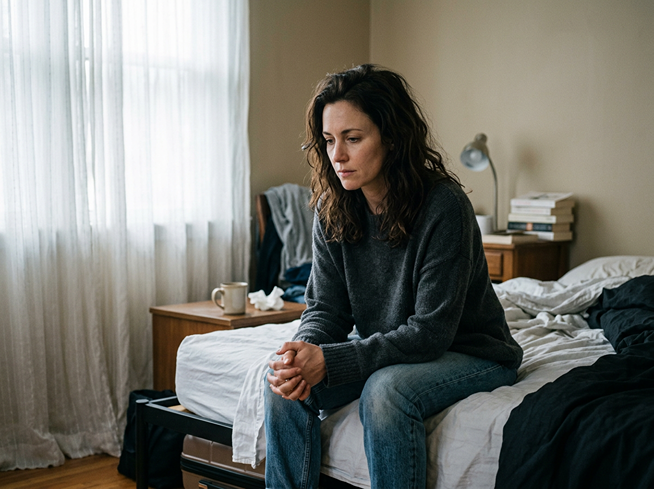
You might be having a good day and even laughing at something when all of a sudden you realize something. You think of a random detail about the affair. You suddenly find yourself back there, your heart racing as you replay conversations and picture things that can never be unseen. Your chest feels tight. And you wonder if this pain will ever stop.
If you're having obsessive thoughts after cheating, you need to know that you're not going crazy. You are not weak. You're not going too far. When you feel like your safety and attachment are in danger, your brain is doing what it's supposed to do.
Let me tell you what's really going on and, more importantly, how you can feel better.
Most people don't know this: obsessive thoughts after infidelity aren't just emotional responses. They're reactions to trauma. Studies show that 50% to 70% of people who find out their partner is cheating on them show signs of Post-Traumatic Stress Disorder (PTSD), which mental health professionals now call Post-Infidelity Stress Disorder (PISD).
Dr. Richard Nicastro, a clinical psychologist who has worked with couples for more than 25 years, says that these intrusive thoughts are like a spiral in which your mind "revs out of control with thoughts, images, and imaginings about the specifics of the affair." A client of his said it best: "It feels like there's an enemy inside my mind."
Researchers call the unanswered questions in your brain "open loops." These questions are begging for closure. When something shocking happens that changes the way you see the world (like finding out your partner cheated on you), your brain opens these loops and starts looking for answers all the time. It's like a TV show that ends with a cliffhanger. Your brain needs to know what happens next, so it keeps watching, listening, thinking, and looking.
But here's the thing: more information doesn't always help with cheating. Sometimes it makes the pain worse.
The Secret Reason You Can't Let Go
Recent research on betrayal trauma has found something very important. A study that came out in 2024 found that feelings of betrayal made people 2.9 times more likely to have mental health problems and 3.3 times more likely to have PTSD symptoms. Another study that followed 600 adults found that people who had been betrayed were much more likely to have higher levels of anxiety, depression, and PTSD symptoms at different times.
It's not really about needing every little thing anymore. At some point, they become a sign that you're feeling very alone and lonely. You need someone to see how much you're hurting. You need to understand that your pain is real and that your feelings are real.
Betrayal trauma theory posits that traumas characterized by significant betrayal, such as infidelity, correlate with increased symptom severity across multiple mental health outcomes, including anxiety, depression, and dissociation. The person you thought would keep you safe was the one who hurt you the most. Your nervous system can't easily forget that.
Some relationship dynamics can keep you in the acute recovery phase, which can make your intrusive thoughts hard to control.
"Just forgive and move on" or "don't dwell on the past" are common pieces of advice that don't really help. You can't think your way out of a trauma response. You shouldn't fight against your nervous system; you should work with it.
The first thing you need to do is learn how to tell when you're emotionally flooding. Some signs are:
Your brain goes into survival mode when you're flooded. You're not being unreasonable; you're using a part of your brain that is meant for survival, not for thinking logically.
Your body feels trauma in the present, but it lives in the past. Grounding techniques tell your nervous system that you are safe right now. Try:
One of the most painful things about having obsessive thoughts after cheating is the need to know every little thing. You might be wondering:
Therapists who help people get over cheating know this: Finding answers to these questions doesn't usually give you the peace you're looking for. More often than not, the details make new pictures that you can't stop thinking about.
Ask yourself, "Will knowing this detail really help me heal, or am I just looking for answers because I want to feel safe again?"
The real question isn't always "what happened?" It's "can I trust you now?" and "will you do the work to help me heal?"
Your mind needs closure, but not always the kind of closure you think it needs. Instead of asking a lot of questions about the affair, focus on:
Studies on overthinking following infidelity differentiate between constructive
information-seeking and detrimental rumination. A 2024 study in the Journal of Trauma & Dissociation says that the key is to learn how to ask yourself, "Is this thought helpful right now?"
If the answer is no, the thought might not be real processing; it could just be a habit or a distraction.
Give this a shot: When you have obsessive thoughts, write them down in a journal. Instead of thinking about these things, try to get them out of your head. Then ask yourself:
This changes you from thinking about problems to doing something about them.
Therapists at NOCD who work with people who have relationship trauma say that there are several evidence-based methods that can help break obsessive thought patterns:
Getting over obsessive thoughts after cheating doesn't mean forgetting what happened or acting like you're fine when you're not. It's about slowly getting back control of your life and mind.
Research on how to get over betrayal trauma shows that healing usually happens in stages. The acute trauma phase can last from a few months to more than a year. But here's the important part: the intensity does go down over time, especially with the right help.
"You don't have to figure out why you were cheated on," says Tracie Ibrahim, a licensed marriage and family therapist and sex therapist. The truth is that you were, and you might never fully understand why. It might seem like thinking about things over and over will help you find answers, but you can't change the past, and too much thinking can hurt you more than help you.
You can change how you deal with your trauma responses right now.
To get over the obsessive thoughts, you need to do the following, whether you stay in your relationship or leave:
Confirming what you've been through: Your reaction to trauma is real and understandable. People who tell you to "just get over it" don't know what betrayal trauma is.
Help from professionals: If you have been through infidelity trauma, you might want to see a therapist who uses trauma-focused methods like EMDR (Eye Movement Desensitization and Reprocessing) or EFT (Emotionally Focused Therapy). Both have been shown to work.
Community and connection: You need people who get it. Support groups for people who have been betrayed can be very helpful because they show you that you're not the only one.
Things you can do to be kind to yourself: Treat yourself the same way you would treat your best friend who is going through this. You're doing the best you can in a very hard situation.
It's normal to think about things obsessively after finding out about infidelity, but you should think about getting professional help if:
Exposure and Response Prevention (ERP) therapy is a specific treatment for OCD that has also shown promise for people whose obsessive thoughts have turned into compulsive behaviors, like constantly checking their phones, following their partners, and seeking too much reassurance.
Your brain is trying to protect you by making you think about things that seem like they're going to kill you right now. You don't have to stay stuck in them forever, though.
With the right trauma-informed tools, professional help, and time, you can go from always being on guard to truly being at peace. You can learn to trust again, whether it's yourself, new people in your life, or your current partner, if you both work on it.
It is not a straight line from having obsessive thoughts after cheating to getting better. There will be days that are good and hard days. Some things that set you off might always hurt a little. But the heavy burden you're carrying right now, the constant mental pain, does get lighter.
You are stronger than you think. You will be able to handle this.
I'm here to help if you can't stop thinking about your partner's infidelity and need support from someone who knows what betrayal trauma is like. At Bliss in Being, I focus on trauma-informed methods that respect your experience and give you useful tools to get your peace back.
You don't have to go through this alone anymore.
Make an appointment with Dr. Cammy today. We'll work together to make a healing plan just for you that meets your needs, helps you deal with intrusive thoughts, and leads you to the peace and clarity you deserve.


.webp)

.webp)

I'm Dr. Cammy. I started Bliss in Being after more than a decade of helping couples and individuals navigate trauma, PTSD, and the painful moments that can reshape a relationship. This work is personal to me—and I bring that to every session
Dr. Cammy also practices in the San Francisco Bay Area at drcammy.com.


.png)

© Copyright 2026, All Rights Reserved by Bliss IN Being—Powered by Progeektech


